

Navigating the Modern Information Ecosystem
A Guide to Misinformation, Disinformation, Malinformation (MDM) and Constructive Engagement

NotebookLM podcast based on this research
Part 1: The MDM Framework: A Nuanced Guide to Problematic Information
In today's hyper-connected landscape, understanding the nature of problematic information is essential for civic health. The MDM model provides a crucial framework for categorizing Misinformation, Disinformation, and Malinformation, clarifying the intent, content, and potential for harm.
Core Definitions and Characteristics
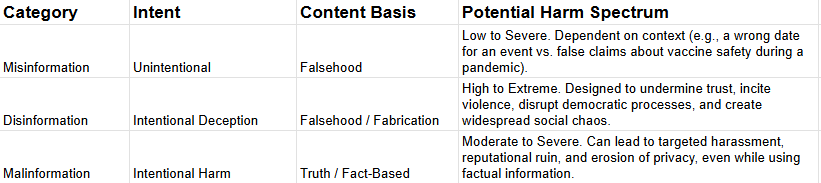
Misinformation: False information shared without malicious intent. It often stems from genuine misunderstanding, memory errors, or the failure to verify information before sharing. While unintentional, its impact can range from negligible to severe, such as sharing incorrect health advice from a well-meaning but uninformed relative.
Disinformation: Fabricated or deliberately manipulated information created and spread with the express intent to deceive and cause harm. This "weaponized" information is designed to manipulate beliefs, sow discord, influence political outcomes, or damage the reputation of an individual or institution. Disinformation campaigns often leverage sophisticated techniques, including bots, deepfakes, and coordinated inauthentic behavior on social platforms.
Malinformation: Genuine information shared with the intent to harm, often by stripping it of its original context. This includes doxing (publishing private information), sharing selectively edited clips to create a false narrative, or weaponizing a person's past statements to damage their present standing. The information is factually true, but its use is malicious.
The Dynamic Spectrum of Harm and Interplay
The lines between these categories are often blurred, and they exist on a dynamic spectrum of harm determined by both intent and impact.
Crucially, these forms of information often interact. A foreign adversary might create a disinformation campaign (e.g., a fabricated video of a political candidate). An individual who believes the video is real then shares it, spreading misinformation. The campaign might also incorporate malinformation by using a real, out-of-context quote from the candidate to make the fabrication seem more plausible.
Counterstrategies: Building Societal Resilience
Addressing the MDM threat requires a multi-layered approach:
Platform Responsibility: Tech companies must enforce policies against coordinated disinformation campaigns and design algorithms that prioritize accuracy over inflammatory engagement.
Education: Media and digital literacy must be foundational components of modern education, teaching critical thinking and source verification skills from a young age.
Journalistic Integrity: A strong, ethical press that prioritizes rigorous fact-checking and provides necessary context is a primary bulwark against all forms of MDM.
Individual Responsibility: Cultivating a personal habit of pausing, verifying, and questioning the source and intent of information before sharing is a critical skill for every digital citizen.
Part 2: Applying Street Epistemology to the MDM Landscape
While societal solutions are vital, one-on-one conversations can be incredibly effective at curbing the spread of MDM at the grassroots level. Street Epistemology (SE) offers a non-confrontational, respectful method for helping individuals reflect on how they have come to hold a belief.
The core SE methodology is universal, but an understanding of the MDM framework can provide the practitioner with valuable context for the conversation. The goal is not to diagnose the information and apply a special technique; it is to use the same technique while being mindful of the potential origins of the belief.
The Core SE Methodology: A Universal Approach
Build Rapport and Establish Consent: Begin with a friendly, respectful tone. The goal is a collaborative exploration, not a debate. "I'm curious about why you believe that. Would you be open to exploring it with me for a few minutes?"
Identify and Clarify the Claim: Understand precisely what the person believes and how confident they are in that belief. "So, to make sure I understand, you're saying X is true. On a scale of 0 to 100, how confident are you?"
Explore the Epistemology: This is the heart of SE. The focus shifts from the claim itself to the reasons and methods used to arrive at the belief. The key question is, "What's the best reason you have to hold that belief?"
Use Socratic Questioning: Gently probe the reliability of the method.
"How did you first encounter that information?"
"How would you know if that method were unreliable?"
"Is it possible for someone to use that same method and arrive at a false conclusion?"
"What makes that source more trustworthy than others?"
Foster Intellectual Humility: The goal is not to "win" but to leave the person with a better toolkit for evaluating beliefs. The conversation may end with a simple, "Thank you for that conversation. You've given me a lot to think about."
How the MDM Framework Informs the SE Practitioner
While the method above remains constant, awareness of MDM helps the practitioner anticipate conversational pathways and underlying factors.
When Engaging with Potential Misinformation:
Context: The interlocutor is likely well-intentioned but has accepted a falsehood. They are often open to new evidence if it's presented after they have examined their own reasoning.
Focus: The SE conversation can gently explore their methods for verification. Questions like, "When you saw that headline, what was your process for checking if it was accurate?" can encourage reflection on verification habits without accusation. The goal is to help them discover the value of fact-checking for themselves.
When Engaging with Potential Disinformation:
Context: The belief may be tied to a strong group identity, deep-seated emotions (like fear or anger), or profound distrust in institutions (media, government, science). The claim is often a symptom of a deeper epistemological framework.
Focus: Directly attacking the claim will likely fail. Instead, focus the SE conversation on the epistemology of trust. Ask questions like: "There are so many sources out there. What's your method for deciding which ones to trust?" or "Who do you think benefits if this information becomes widely believed?" This shifts the focus from the factoid to the larger system of belief, which is the true target of disinformation.
When Engaging with Potential Malinformation:
Context: The interlocutor is using a factual piece of information. The problem is the lack of context or the malicious intent behind its use.
Focus: Since the core fact is true, the SE conversation should explore the ethics and reasoning surrounding its use and interpretation. Ask questions that reveal the importance of context: "Is it possible that presenting a fact without its full story could lead to an inaccurate conclusion?" or "Do you think there might be more to this story that we're not seeing?" This encourages reflection on fairness, perspective, and the ethical responsibilities of sharing information.
By remaining focused on the universal SE method while using the MDM framework as a contextual lens, practitioners can have more productive, empathetic, and ultimately effective conversations that help build a more resilient and thoughtful society, one conversation at a time.
https://www.mdpi.com/2076-0760/14/3/133#:~:text=Misinformation%20may%20be%20inadvertent%20or,2023)
https://princetonlibrary.org/guides/misinformation-disinformation-malinformation-a-guide/